
Mnemon is a local MCP server that gives AI coding agents persistent project memory. It stores branch-scoped session state and project-scoped knowledge in SQLite, then exposes that information through MCP tools and a CLI.
The goal is straightforward: a new coding session should begin with the project context, active work, and recorded decisions that Mnemon already knows—not with an empty conversation.
Why a new session starts from zero
An agent can use context from its current conversation, but that context is not automatically a durable project record. When a new session starts, the agent can inspect the repository, but it does not necessarily know which decisions were made, which task is blocked, or why a directory should not be changed.
That missing context is practical rather than abstract. A developer may need to re-explain:
- Which branch they’re on and why
- What architectural decisions were made in the last sprint
- Which components depend on which
- What tasks are in progress, blocked, or completed
- What they learned from the last bug they fixed
- Which files are important and why
The model: session memory plus project memory
Mnemon separates information that changes with active work from information that describes the project more generally. Both layers use one SQLite database at ~/.agent-memory/mnemon.db.
Session memory is persistent and branch-scoped rather than ephemeral. It includes branch focus, tasks and their lifecycle, branch-specific decisions, global decisions, and session summaries. Switching branches changes which branch-scoped state is read, while the records remain stored in SQLite.
Project memory is the knowledge graph. It stores project-level entities, observations, and typed relationships. An entity can optionally have a branch filter, but entity names are unique within a project rather than independently duplicated for every branch.
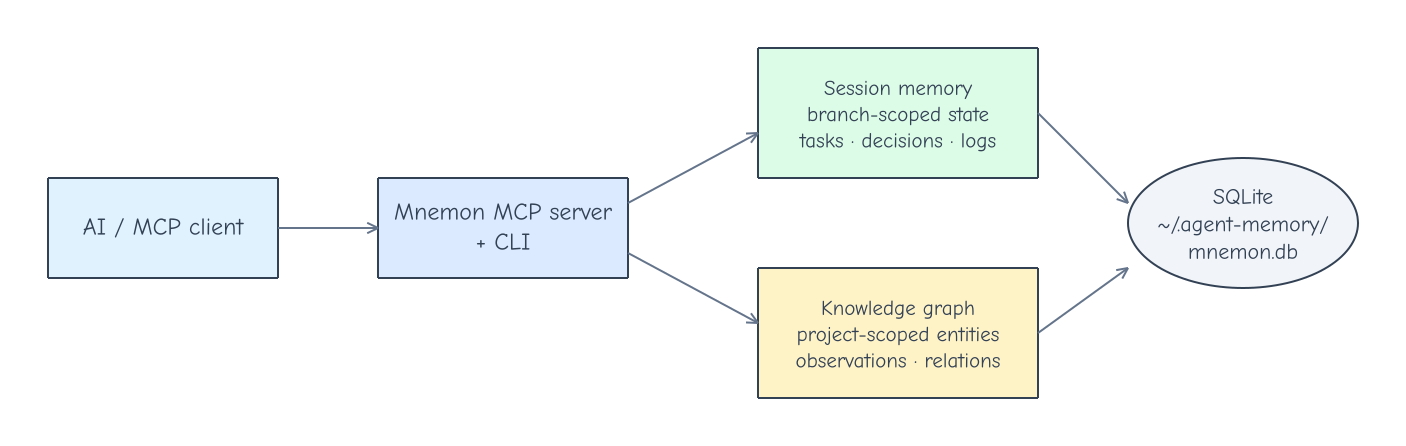
Diagram by Paulo Cruz, CC-BY-4.0.
The separation answers two different questions:
- Session memory: “What am I working on in this branch?”
- Project memory: “What exists in this project, and how is it related?”
What the knowledge graph stores
An entity is something worth remembering: a component such as PaymentService, a concept such as a rate-limiting strategy, a file, a person, or a system. Each entity has a type, a name, and an importance score from 0.0 to 1.0.
Observations are normally appended rather than updated in place. They can also be explicitly deleted, so they are not an immutable audit history. If a fact changes, an agent can delete the stale observation and add a replacement.
Relationships are directed and typed. Mnemon includes relationship types such as calls, implements, depends_on, owns, uses, extends, and triggers, while also allowing custom types. A calls relationship from OrderService to PaymentService records the direction of that relationship.
During automatic context assembly, Mnemon applies an importance threshold of 0.4 and caps the graph contribution at 15 entities. This keeps the session-start context focused rather than dumping every recorded file, function, or component into the conversation.
What happens when a session starts
The session-start path is the main user journey:
- Global project context — the high-level description of what this project is
- Global decisions — architectural decisions that apply everywhere, not just one branch
- Knowledge graph entities — grouped by type and filtered by importance
- Branch focus — what this specific branch is about, what the next steps are
- Branch decisions — decisions scoped to this branch
- Tasks — with status icons (todo, in-progress, blocked, done)
- Recent sessions — what happened in previous sessions on this branch
The agent requests this context through memory_read(project_id, branch). Mnemon derives the project identifier from the final two path components of the Git origin remote and detects the current branch with:
git rev-parse --abbrev-ref HEAD
The result is a Markdown context block that the MCP client can provide to the agent before work begins.
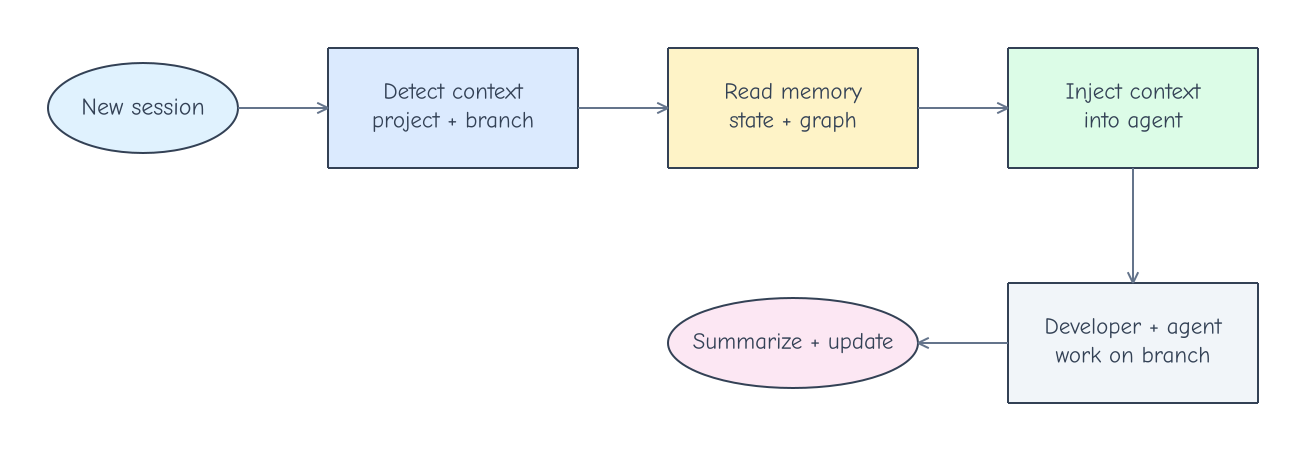
Diagram by Paulo Cruz, CC-BY-4.0.
Branches, projects, and hierarchy
Mnemon supports parent-child project relationships for repositories that contain multiple services or related projects. Direct children can be listed with project_list_children; recursive descendants can be listed with project_list_tree.
The implementation uses SQLite WITH RECURSIVE CTEs to traverse the hierarchy. Cycle prevention happens before a proposed parent change is written: an ancestor query rejects self-parenting and ancestor cycles. The descendant queries themselves are traversal queries, not independent cycle detectors.
Project identity and branch detection come from Git context, while hierarchy operations let a developer inspect how projects relate. This makes the feature useful for monorepos without requiring a separate project registry.
SQLite and the async boundary
The data layer uses aiosqlite. Mnemon opens managed SQLite connections asynchronously, enables WAL mode and foreign-key enforcement on those connections, and awaits database operations without blocking the event loop in the same way a synchronous call would.
This is an integration boundary rather than a guarantee of unrestricted database parallelism. Async operations avoid synchronous event-loop blocking, but SQLite still controls locking and concurrency.
WAL (Write-Ahead Logging) and foreign-key enforcement are enabled by Mnemon on each managed connection. WAL can allow readers to proceed while SQLite handles a write, but it does not remove SQLite’s locking model.
The schema bootstrap uses idempotent DDL such as CREATE TABLE IF NOT EXISTS and CREATE INDEX IF NOT EXISTS. Re-running the current bootstrap is designed to be safe for existing objects; it is not a versioned migration system and does not provide rollback history.
MCP and CLI interfaces
Mnemon exposes 15 tools through the Model Context Protocol, built with FastMCP. They cover reading context, persisting session work, maintaining the graph, and navigating projects:
-
memory_read— the session-start brain dump -
memory_summarize— persist session-end summary, decisions, and task updates -
memory_task_update— update task status -
memory_project_set_context— update global project context -
memory_log_commit— record a commit in session history -
memory_project_list— list projects -
project_set_parent— set a project’s parent -
project_list_children— list direct children -
project_list_tree— list descendants recursively -
graph_entity_upsert— create or update an entity -
graph_observe— add an observation -
graph_relate— add a typed relationship -
graph_search— search entity names and observations -
graph_read— read graph entities, observations, and relations -
graph_forget— delete graph records
The CLI is the human-facing entry point. mnemon serve starts the MCP server, while commands such as read, graph, and prune inspect or maintain local memory. Commit logging is available through mnemon log-commit and is intended to be usable from a Git hook; the current release does not install that hook automatically.
The mnemon install command copies a SKILL.md file to .github/skills/mnemon/ in your repo. This tells the AI agent how to interact with the memory system — which tools to call, when to read, when to write, and how to format the data it stores. It’s the bridge between the agent’s understanding and Mnemon’s API.
Trade-offs and boundaries
Mnemon chooses a small local system over a broader infrastructure footprint.
No vector search. Entity search uses SQL LIKE queries rather than embeddings. That avoids an embedding model and vector database, but it also means search is based on stored text rather than semantic similarity.
Single-file SQLite. All projects share one local database by default. The default path is ~/.agent-memory/mnemon.db, and MNEMON_DB_PATH can change it. The reviewed design is local-first and single-user; it does not provide replication, shared team memory, or cloud synchronization.
Observations are append-oriented. New facts are added rather than replacing existing rows in place, but records can be deleted. That gives agents an explicit correction path without claiming immutable history.
Memory still depends on updates. Mnemon reads and writes a live local SQLite database for its operations. Git supplies project and branch context, but the knowledge graph is not reconstructed automatically from repository files. If agents do not update the records, stored context can drift from the codebase.
These boundaries make Mnemon a reasonable fit for a developer who wants inspectable local memory and MCP integration without operating another service. They are less suitable if the requirement is shared, replicated, semantically searched team memory.
Getting Started
Mnemon requires Python 3.11+. Install with uv:
uv tool install mnemonn
Initialize memory for your current repository:
mnemon init
mnemon install
Start the MCP server for agent integration:
mnemon serve
Or inspect your memory directly:
mnemon read
mnemon graph
mnemon prune --importance-below 0.3 --older-than-days 30
The package distribution is named mnemonn, while the installed executable is mnemon. Mnemon requires Python 3.11 or newer and has no external service requirement; its Python dependencies are installed with the package.
The database lives at ~/.agent-memory/mnemon.db unless MNEMON_DB_PATH changes the location. It can be backed up or inspected with a SQLite client.
Who Mnemon is for
Mnemon is for developers who want a new AI coding session to begin with durable project and branch context, while keeping that memory local and inspectable.
It is not a replacement for source control, documentation, or team collaboration infrastructure. Its value depends on agents and developers recording useful decisions, tasks, observations, and summaries as work progresses.
Mnemon is open source under the MIT license. The full source code is available on GitHub.